

Frameless Torque Motors
Frameless brushless motor kits and thin-profile torque-motor configurations for custom robotic joint and machine integration.
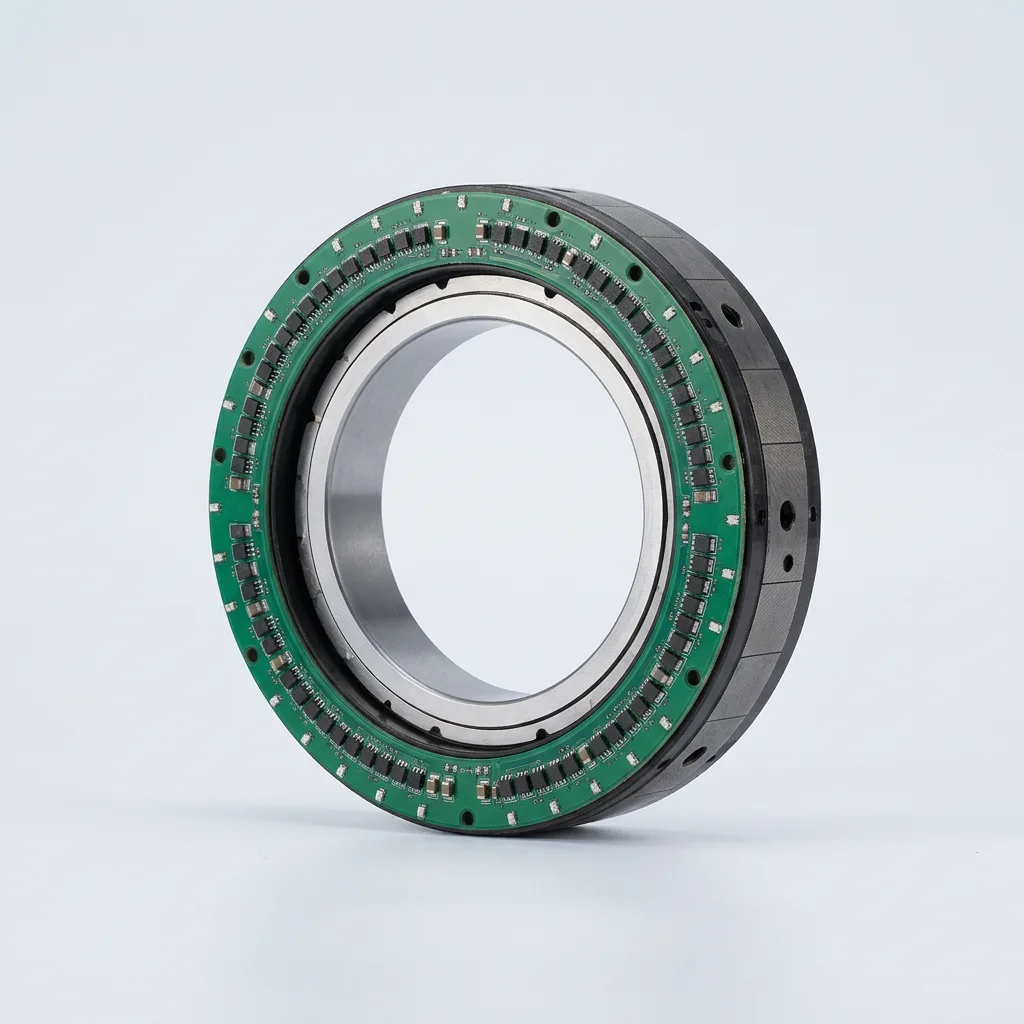
A frameless motor is a rotor-and-stator set intended to become part of the customer's mechanical assembly. Unlike a complete housed actuator, it requires suitable bearing support, alignment, retention, thermal management and feedback integration. Ring-shaped and hollow-bore layouts can help a designer arrange services through an axis, but the finished joint's loading and operating capability depend on the surrounding assembly as well as the motor.
Product types and configurations
Frameless brushless motor kits
Separate rotor and stator components for integration into a purpose-designed assembly. Confirm winding, retention method, feedback and drive requirements during selection.
Thin-profile torque motors
Low axial-profile arrangements for constrained joint designs. Diameter, thermal path and the required torque-speed operating points must be considered together.
Hollow-bore configurations
Annular motor layouts can leave room for a shaft or service routing. Confirm usable assembly clearance rather than equating the motor bore with finished routing space.
Motor sets for geared or direct-drive axes
A motor set may form part of a direct-drive axis or a geared joint. The transmission, support bearings and controller remain separate selection decisions.
Typical applications
- Custom rotary joints and robotic wrists
- Compact positioning axes and rotary mechanisms
- Humanoid and mobile-manipulator joint development
- Equipment-builder motor integration projects
Technical selection
Define motor-side operating points
Provide continuous and peak motor torque, speed, peak duration and duty cycle. For geared axes, also provide the required output conditions and proposed transmission.
Thermal conditions
State ambient conditions and the proposed stator mounting and heat-removal path. Continuous ratings depend on the specified thermal conditions of the integrated assembly.
Mechanical clearances
Review bore, axial space, air-gap control, concentricity, shaft retention and bearing arrangement. Assembly tolerances must follow selected-component documentation.
Electrical and feedback requirements
Specify supply provision, winding constraints, commutation feedback and the drive to be assessed. Encoder fit and electrical compatibility require explicit confirmation.
Integration considerations
Design the supporting assembly
Establish housing, shaft, bearings and rotor retention before finalising the motor selection. The motor kit is not a complete supported joint.
Control assembly and handling
Plan controlled handling of magnetic parts, air-gap inspection and lead routing. Follow the selected kit's mounting and adhesive or fastening instructions.
Validate the complete axis
Check rotation, commutation, current limits, temperature and feedback direction in the finished assembly. A motor test alone does not qualify the complete robot joint.
Image reference and scope
Configurations are available for project-specific selection and integration review. Ratings, interfaces, availability and documentation are confirmed for the selected configuration, not inferred from the illustrative image.
Frequently asked questions
Is a frameless motor a complete joint actuator?
No. It supplies the electromagnetic motor elements. Bearings, housing, feedback, transmission where needed and drive electronics must be integrated or separately selected.
Does a hollow bore guarantee through-cable routing?
No. The finished shaft, bearings, encoder, brake and cable bend limits can reduce the usable space. Review the complete cross-section and motion range.
Can a catalogue motor torque be treated as joint output torque?
Only if the axis arrangement and operating conditions justify it. A geared design requires a separate transmission and output-load assessment; direct drive still needs thermal and structural validation.
Discuss this application
Email our team with your application and component requirements.
Discuss this application