

Servo Drives & Joint Control
Compact servo drives and joint-control electronics available for project-specific assessment alongside motors, feedback and host controllers.
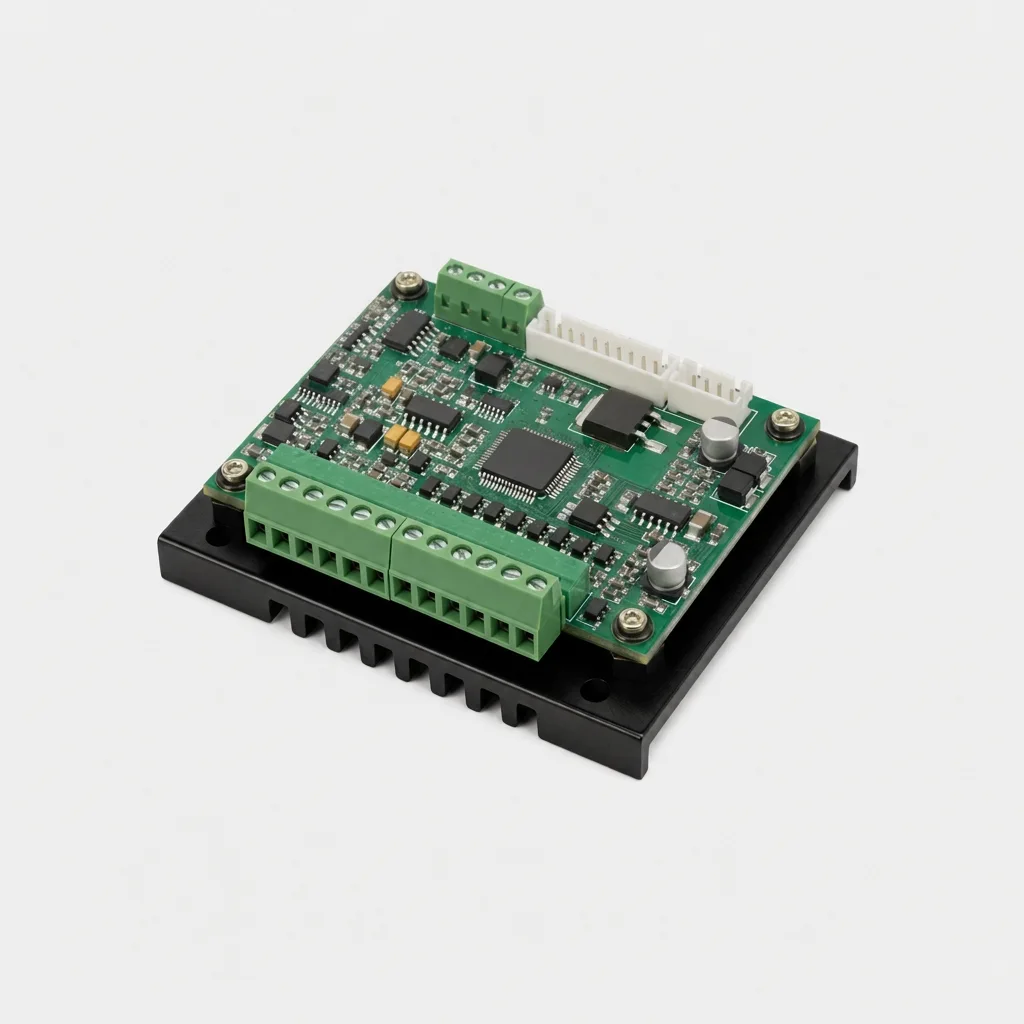
Servo drives regulate motor operation within an agreed electrical and control architecture. Joint-control electronics may also coordinate feedback, temperature inputs and local control functions, depending on configuration. These components are distinct from the robot's host controller, navigation stack or fleet software. Establish the motor, sensor and host interfaces first, then assess the required power stage, operating modes and communications without assuming universal device compatibility.
Product types and configurations
Compact servo drives
Power and control electronics selected around the motor and supply. Confirm operating modes, current limits, thermal conditions and protection requirements for the intended axis.
Joint-control electronics
Local electronics can support a distributed joint architecture. Define which functions remain at the joint and which belong to the robot's host controller.
Encoder and sensor interfaces
Incremental or absolute feedback, temperature and sensing inputs are configuration-dependent. Confirm electrical levels, encoding, wiring and timing against the selected devices.
Application-specific communications
Host-to-drive communication must be selected and verified for the actual electronics and software versions. No universal protocol or controller compatibility is implied.
Typical applications
- Custom robotic joint control
- Distributed actuator architectures
- Robotic arm and mobile-manipulator axes
- Automation equipment motor-control integration
Technical selection
Power and motor matching
Provide motor electrical data, continuous and peak current needs, supply limits and thermal conditions. State regeneration and braking-energy requirements during the application review.
Feedback compatibility
Identify the exact encoder or sensing device and required position information. Connector fit alone does not establish electrical, data-format or timing compatibility.
Control responsibilities
Define command modes, loop responsibilities, update requirements, homing and fault handling between local electronics and the host controller.
Wiring and environment
Specify enclosure, grounding, shielding, connector retention, cooling and operating environment. Required compliance evidence must be reviewed for the selected configuration.
Integration considerations
Coordinate with existing controllers
Use the controller and autonomy pages to define the wider architecture. Joint drive selection does not replace navigation, fleet coordination or robot-level control.
Agree commissioning inputs
Plan motor identification, feedback direction, current limits, tuning, limits and fault recovery. Validate the motor-drive combination before unrestricted motion.
Assess safety separately
Protective and certified safety functions require explicit documentation and system-level assessment. Ordinary control inputs or a holding brake do not establish a certified safety function.
Image reference and scope
Generic technical illustration of a control-electronics option, not a photograph or specification of a verified supplied model. Configurations are available for project-specific selection and integration review. Ratings, interfaces, availability and documentation are confirmed for the selected configuration, not inferred from the illustrative image.
Frequently asked questions
Will a drive work with any robot controller?
No. The host interface, command modes, electrical requirements, software integration and timing must all be checked for the exact drive and controller combination.
Can you confirm a communications protocol from an image?
No. Appearance and connector shape are insufficient. Share the required protocol and device documentation so the project-specific interface can be reviewed.
Is a servo drive the same as a robot controller?
No. A drive acts on a motor axis; a host controller coordinates robot behaviour and may communicate with multiple drives. The allocation of control functions must be agreed.
Discuss this application
Email our team with your application and component requirements.
Discuss this application