

Linear Actuation & End-Effector Components
Electromechanical linear motion, electric gripping and compact actuation options for project-specific robotic mechanisms and end effectors.
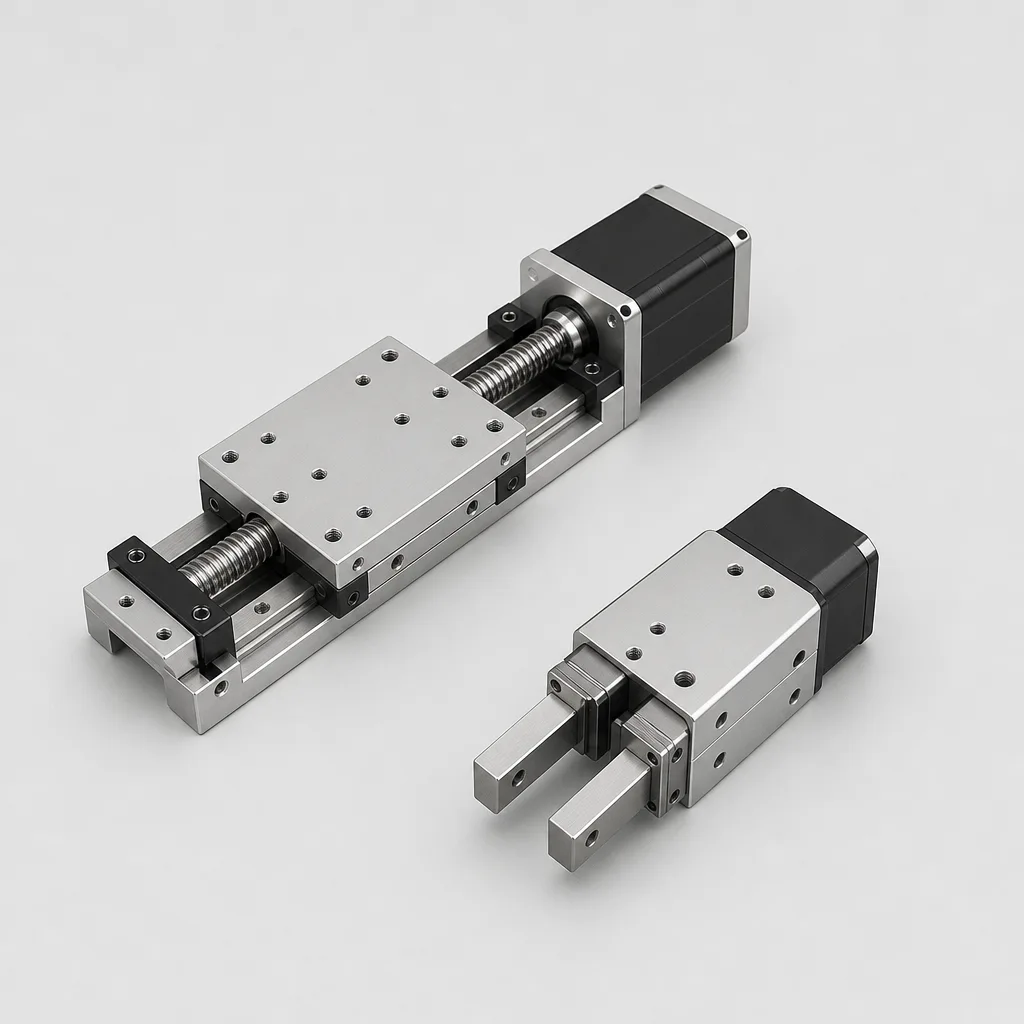
Linear actuation converts motor motion into controlled translation, while grippers and compact hand mechanisms interact with a workpiece. Screw-driven assemblies, electric grippers and small actuation components can be considered as supply and integration options for an agreed project. They are not presented as verified stocked models. Selection starts with force, travel, motion profile and workpiece handling, not a visual similarity to an existing mechanism.
Product types and configurations
Electromechanical linear actuators
Motor-driven linear assemblies are assessed against required thrust, stroke, speed, duty cycle and mounting. Side loads and external guidance require separate consideration.
Screw-driven assemblies
Screw and nut mechanisms can form part of a custom actuator. Review screw lead, support, lubrication and permissible speed and loading for the selected arrangement.
Electric grippers
Gripping configurations are selected around the workpiece, finger geometry, stroke and required gripping behaviour. Confirm whether force or position adjustment is supported.
Compact hand and end-effector actuation
Small rotary or linear components may support custom fingers and tools. Define the mechanism, transmission, sensing and cable routing before choosing components.
Typical applications
- Robotic grippers and custom end effectors
- Compact linear positioning and transfer mechanisms
- Robotic hand and finger development
- Laboratory and manufacturing handling equipment
Technical selection
Force and motion profile
Provide continuous and peak linear force, stroke, speed, acceleration and duty cycle. State orientation and whether the load acts in tension or compression.
Guidance and screw loading
Review external guidance, side loads, screw support, critical speed and compression buckling where relevant. An axial thrust rating does not establish side-load capacity.
Workpiece and gripping conditions
Describe workpiece mass, shape, surface, fragility, friction and movement. Finger length, offset and acceleration affect the grip required; avoid selecting on a headline force alone.
Feedback and environment
Define end-position or continuous feedback, control and power requirements, access, contamination and temperature. Environmental ratings and holding behaviour need configuration-specific confirmation.
Integration considerations
Define the mechanical interface
Agree mounting, alignment, travel limits, stops, finger attachment and service access. A linear assembly or gripper must be assessed within the complete mechanism.
Coordinate power and control
Confirm drive provision, feedback, host interface and wiring. Establish homing, gripping confirmation and fault response without assuming compatibility with every controller.
Validate the handling task
Test representative workpieces and motion conditions, including load retention and recovery after power loss. Protective measures belong to the system risk assessment.
Image reference and scope
Generic technical illustration of linear and gripping options; it is not a photograph of verified stocked models. Configurations are available for project-specific selection and integration review. Ratings, interfaces, availability and documentation are confirmed for the selected configuration, not inferred from the illustrative image.
Frequently asked questions
Are these products held in stock?
No stock or immediate-availability claim is made. These are researched project-specific supply and integration options; the exact configuration, documentation and delivery terms require confirmation.
Can linear force be inferred from motor torque alone?
No. Screw lead, transmission arrangement, efficiency, friction, speed and mechanical limits affect output force. Review the complete actuator rather than using a motor rating in isolation.
What is needed to select a gripper?
Share workpiece geometry and mass, contact surfaces, finger concept, motion cycle, required stroke and feedback, environment, control interface, quantity and project stage.
Discuss this application
Email our team with your application and component requirements.
Discuss this application