

Precision Robotic Reducers
Strain-wave, precision planetary and cycloidal transmission options for application-specific robot joints and positioning axes.
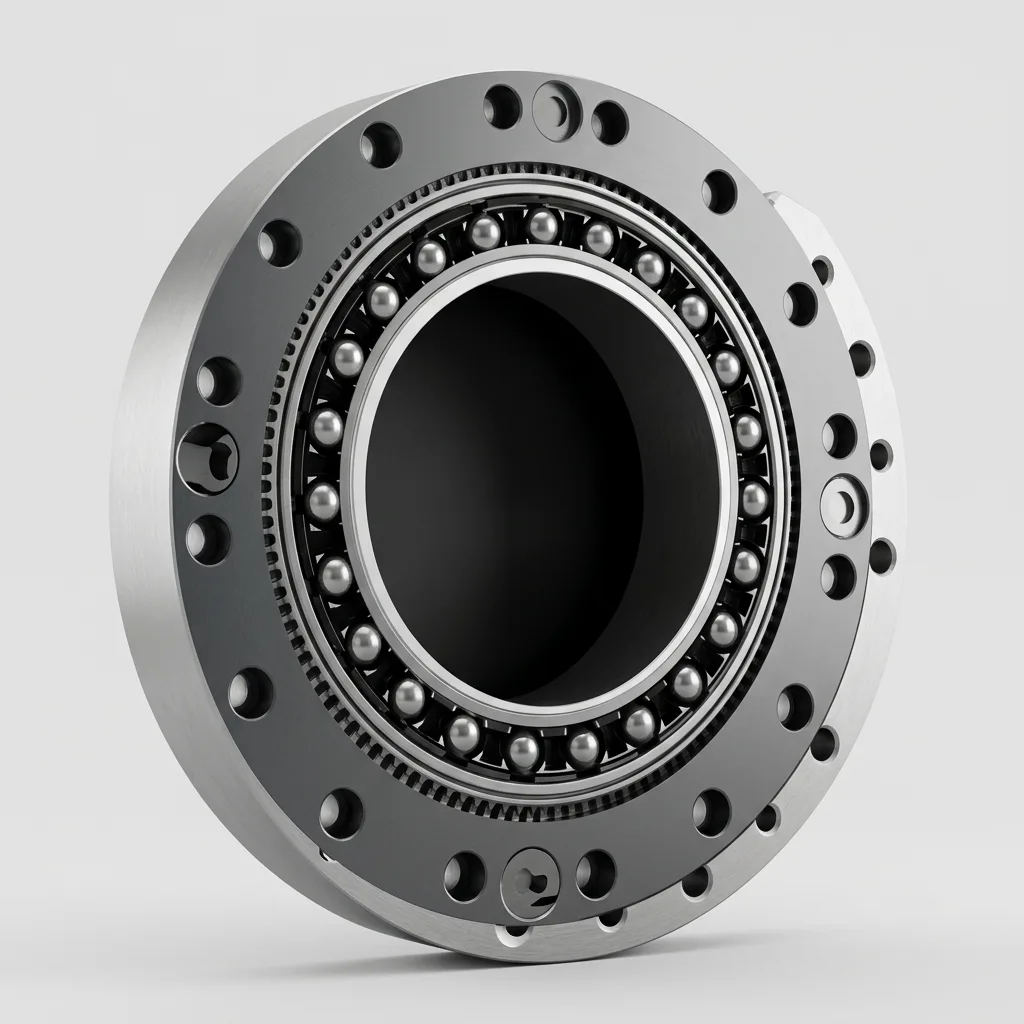
A robotic reducer is a transmission component that changes speed and torque between an input and an output. It is not a complete powered joint. Strain-wave, planetary and cycloidal mechanisms offer different packaging and operating characteristics; the appropriate choice depends on the axis, load cycle and required motion behaviour. Hollow-shaft options are assessed where applicable, without assuming every transmission includes an output bearing, motor or feedback device.
Product types and configurations
Strain-wave reducers
Compact reduction mechanisms using an elastically deforming gear element. Review the selected unit's permissible loads, lubrication and duty conditions rather than inferring zero backlash.
Precision planetary reducers
Planetary gear arrangements for geared motion axes. Ratio, permissible input speed, output torque, lost motion and bearing provision are assessed for the selected assembly.
Cycloidal reducers
Cycloidal reduction mechanisms for suitable rotary applications. Packaging, shock loads and torsional behaviour should be compared against the actual axis requirements.
Hollow-shaft and bearing arrangements
A hollow passage or integrated support bearing may be available in a selected configuration. Confirm the usable bore, mounting datums and supplied bearing functions explicitly.
Typical applications
- Robotic arm, waist and leg transmission stages
- Rotary positioning and automation axes
- Custom geared actuator development
- Equipment requiring compact speed reduction
Technical selection
Input and output conditions
Specify reduction ratio, input speed and required continuous and peak output torque. Do not multiply motor torque by ratio and ignore losses or transmission limits.
Motion behaviour
Define acceptable backlash or lost motion, torsional stiffness and positioning requirements. Repeatability and absolute accuracy are different properties and need separate assessment.
External loads and shock
Provide radial, axial and moment loads, reversals, emergency-stop conditions and the expected motion cycle. Confirm which loads the output support arrangement can carry.
Mounting and maintenance
Review alignment, shaft fits, mounting stiffness, lubrication, sealing and access. Environmental suitability and service requirements must be confirmed for the exact reducer.
Integration considerations
Complete the powered axis
Match the transmission with a motor, support structure, drive and feedback arrangement. A reducer family name does not identify a finished joint configuration.
Review the load path
Use drawings to establish bearing support and where external forces enter the mechanism. Confirm alignment and fastening requirements before assembly.
Validate output performance
Assess the assembled axis under representative loading and temperature. Encoder resolution alone cannot establish the reducer or system's absolute output accuracy.
Image reference and scope
Illustrative reconstruction of a reducer assembly. The image does not establish internal construction, dimensions, ratio or a verified supplied model. Configurations are available for project-specific selection and integration review. Ratings, interfaces, availability and documentation are confirmed for the selected configuration, not inferred from the illustrative image.
Frequently asked questions
Does a reducer include a motor?
Not unless a specific integrated module is selected and documented. A standalone reducer supplies transmission functionality and must be integrated with the other axis components.
Are all precision reducers backlash-free?
No blanket claim is appropriate. Backlash, lost motion and stiffness depend on the mechanism, assembly, load and test conditions; request configuration-specific documentation.
Which reducer type is best for a humanoid?
There is no single choice for every joint. Compare packaging, torque-speed requirements, external loads, motion cycle, controllability and the robot's overall mechanical architecture.
Discuss this application
Email our team with your application and component requirements.
Discuss this application